Can Sealcoating Buy Your Parking Lot a Few More Years Before You Repave?
by Hanna Carolina · 5 min read
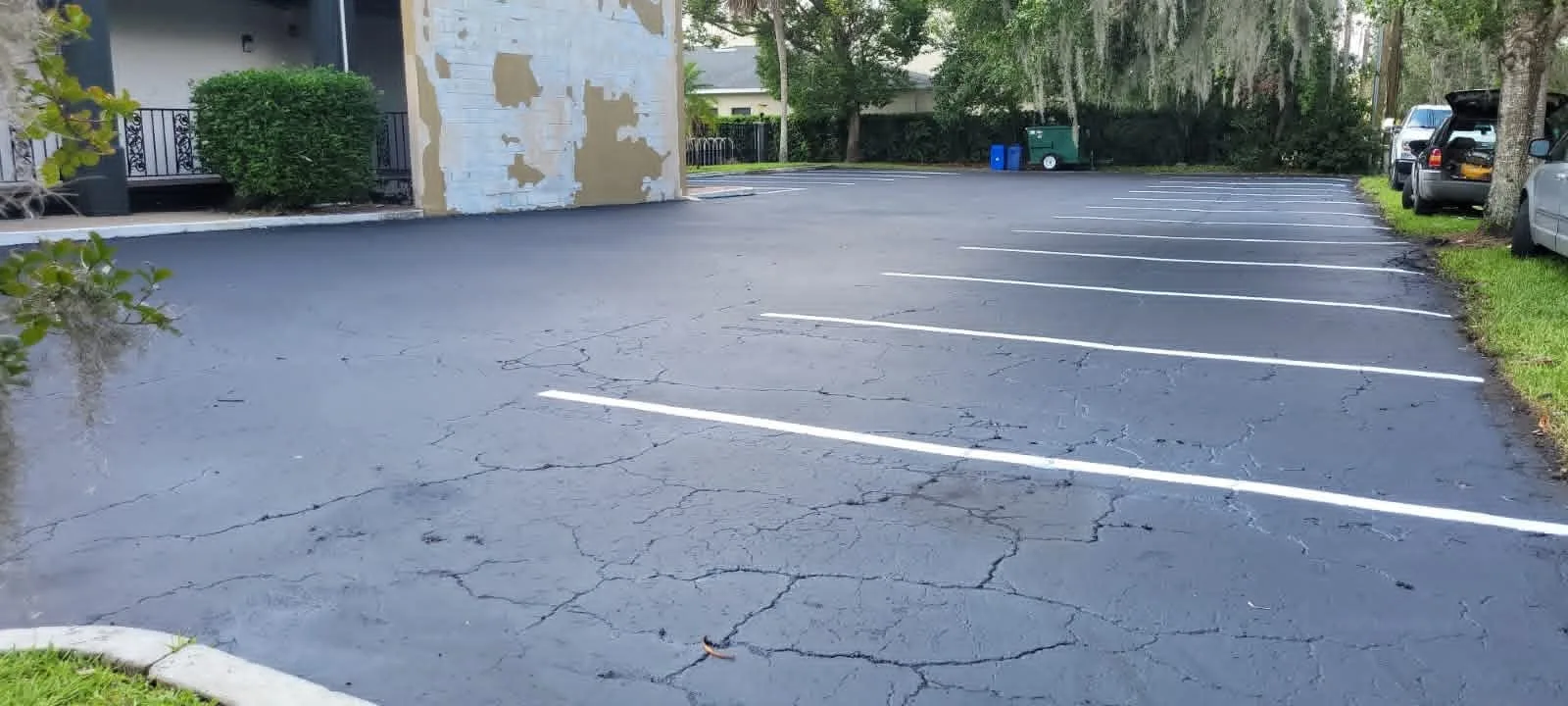
Often, yes. If the rock base under the lot is still solid and the cracking is still in lines rather than spread across the surface, crack filling followed by a fresh seal and new striping costs a fraction of an overlay and buys real years. What it cannot do is rescue a lot whose base has already failed.
That is the conversation worth having before you approve anything, because the two jobs are priced nowhere near each other. If you have a resurfacing quote in front of you and the number is not in this year's budget, call us for a second look or ring (386) 215-7466. We will walk the lot and tell you which one it actually needs.
What is sealcoating actually protecting a lot from?
Weather, mostly. Juan puts it plainly: sealcoating protects the asphalt from the weather and gives the surface more lifespan. Sun bakes the binder that holds the aggregate together until the surface goes gray and brittle, and every afternoon storm sends water down into whatever cracks have opened up. A seal coat puts a sacrificial layer over the top so the sun and the water work on that instead.
Central Florida is harder on a lot than most of the country in this respect, because it delivers both extremes in the same afternoon. A surface bakes at midday and then takes an inch of rain at four o'clock. Oil drips from parked cars soften the binder in exactly the places tires sit, which is why the parking stalls in a lot usually look worse than the drive lanes do.
Our asphalt sealcoating page covers what goes on the lot and in what order. Sealer alone is not the whole job. The cracks get filled first, because sealer poured across an open crack simply follows it down and disappears.
When is crack filling and sealcoating still enough?
While the cracks are still running in lines and the base underneath has not moved. Long cracks along the direction of traffic, or the joints where two paving passes met, are surface problems. They open, water gets in, and filling them stops that. A lot in that condition can be crack filled, sealed and restriped, and it will look close to new when the crew leaves.
Most of the commercial work we do is exactly this. A property manager is looking at a resurface number, does not want to spend it, and the honest answer is that the lot does not need it yet. Crack filler, seal and stripe is the cheaper package and it keeps the surface protected while the budget catches up. It is a maintenance decision rather than a repair, and it works best when it is done before the lot looks bad, not after.
If parts of the lot are further gone than the rest, those sections can be cut out and rebuilt on their own before the seal goes down. That is crack filling and asphalt repairs, and pairing it with a seal is usually cheaper than treating the whole lot as one failed surface.
When does sealing stop being worth the money?
Once the cracking turns into a web instead of lines. Alligator cracking, where the surface breaks into interlocking pieces like reptile skin, means the base under it is flexing. The asphalt is no longer being held up. Sealer over that is a cosmetic layer on a structural problem, and it will crack through in a season.
Juan's threshold on a driveway is alligator cracks wider than about a quarter of an inch, and a lot of them. The same logic applies on a commercial lot, though a lot rarely fails evenly. The truck route and the dumpster pad usually go first because that is where the axle loads are, while the far corner of the lot may still be perfectly sound. A contractor who tells you the whole surface has to come out without walking it section by section has not looked hard enough.
Where the base genuinely has failed, sealing it is money you will spend again next year. That is when commercial asphalt paving becomes the cheaper answer over any horizon longer than about eighteen months.
What should you ask before approving the work?
Ask the contractor to show you where the base is sound and where it is not, on the lot, with you standing there. Ask whether cracks are being filled before the sealer goes on. Ask whether the striping is included or billed after. And ask what happens if a section fails inside the year, because a seal job with no answer to that question is being sold, not specified.
At M&S Asphalt Paving we would rather tell you the lot has three more years in it than sell you an overlay you do not need yet. Juan has twenty two years in asphalt, including DOT road work, and he prices a job after looking at the surface in person. Walk your lot with us, get in touch here or call (386) 215-7466, and you will get a straight answer on which job it is. Estimates are free and usually go out the same day or the next.