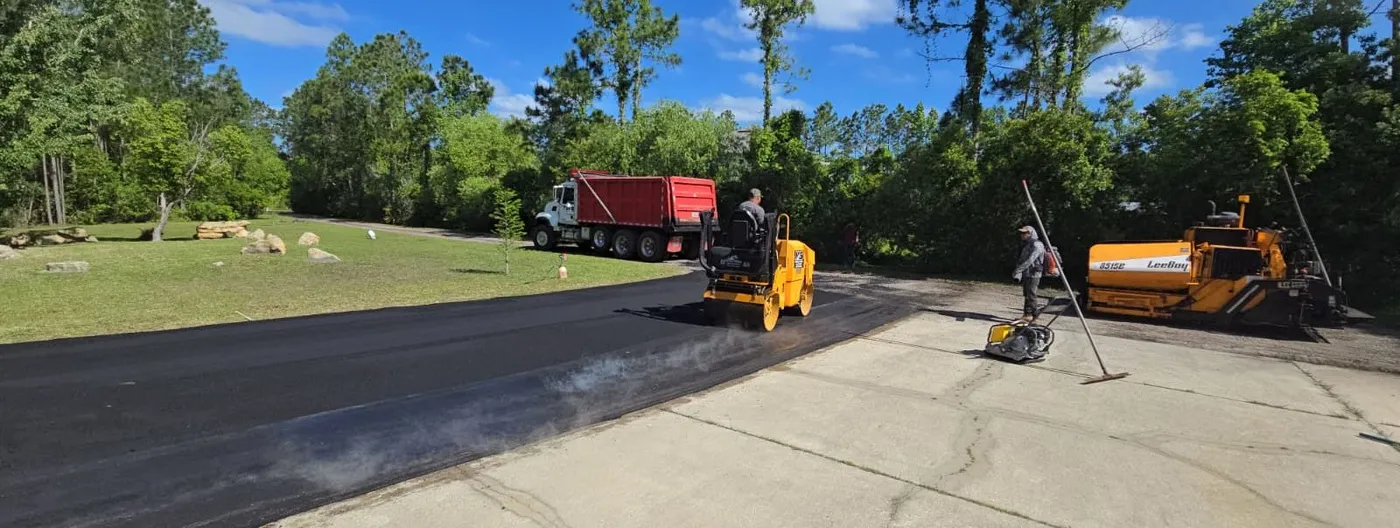
Driveway Pavingin DeLand, Florida
A new driveway is one of the bigger exterior investments a homeowner makes. Most of the work happens before any asphalt goes down. M&S Asphalt Paving builds residential driveways across DeLand and Volusia County on a real compacted base at full two-inch thickness. That is the difference between a driveway that lasts 10 to 15 years and one that alligators and sinks in three.

Built from the Ground Up
What goes into a new asphalt driveway?
Most of the work on a new driveway happens before any asphalt is laid. We start by clearing and grading the area so the finished surface sheds water toward the street or yard rather than pooling against the house or garage. That slope is set at the grading stage. Once it is in the ground, you cannot correct it without tearing everything up.
Next comes the base. Crushed concrete or lime rock compacted in lifts until it is solid and level. This is the foundation the driveway's lifespan depends on. When we are satisfied the base is right, asphalt goes down at two full inches and gets compacted with a roller for density, not just smoothness. We also set the transitions carefully, where the driveway ties into the garage slab and where it meets the road, because those two joints are where water collects and edge cracking starts if the grade is off.
Throughout the job we explain what is happening and why, because a homeowner putting this kind of money into a project should understand what is going into the ground under their pavement. Learn more about the sitework and base preparation that goes into every build.
Hot-Mix Asphalt
Compacted with a roller for density throughout, not just surface smoothness. The layer you drive on and see every day.
2 inches standard, more for heavy vehiclesCompacted Road Base
Crushed concrete or lime rock laid and packed in six-inch lifts. This is what the asphalt sits on. The surface lasts as long as the base holds.
6-inch minimum, compacted in liftsNative Subgrade
Volusia County sandy soil. Moves with moisture and traffic more than most homeowners expect. The base isolates the asphalt from that movement.
Graded for drainage before base is placed
The Part That Determines Everything
Why does the base matter more than the asphalt you can see?
Asphalt is flexible by design. It needs something firm and compacted underneath to carry the load of vehicles and spread it out. Without a base, the ground shifts with every rain and every car that rolls over it. The asphalt follows, and the surface cracks into that tight alligator pattern before it starts to sink.
Plenty of low-bid crews skip the base and lay asphalt straight on dirt or gravel. It saves them money on the job and costs the homeowner a driveway. Central Florida's sandy soil moves more than most people expect, so this is not optional here. When someone calls us about a driveway that failed in two seasons, the story is almost always the same missing foundation.
The DOT work Juan did before starting M&S held crews to real compaction standards. We carried those habits directly into how we build a residential driveway. The base gets built and checked before a single ton of asphalt arrives. That is the step that explains why our driveways tend to last. More about how Juan and Maria run the business.
2″
Asphalt Thickness
Standard residential. What we quote is what gets poured.
6″
Base Depth
Compacted in lifts. Dense and consistent all the way down.
10-15
Year Surface Life
Built on a proper base, maintained with sealcoating on schedule.
2-3
Years Without Base
Typical lifespan when asphalt is poured straight onto native soil.
Repair or Replace?
When should you replace a driveway instead of repairing it?
Replace the driveway when the cracking is widespread and structural, not just a few isolated spots. The clearest signal is alligator cracking across a large area, especially cracks wider than a quarter inch, because that means the surface has broken down from the base up and patching will not hold. We come out, look at what is there, and give you an honest assessment. No pressure either way.
Repair done right still means rebuilding the base.
We cut out the failed section, excavate to the base, rebuild it in six-inch lifts, and pave over it so the patch is as strong as the surrounding driveway. Not a cold-fill pour-and-roll. For more on how we handle repairs, see the asphalt repair page.
Repair Is the Right Move
Isolated Damage, Sound Base
- One or two potholes, no spread
- Edge cracking along one section
- Hairline cracks across a small area
- Surface drains well after rain
- No heaving or sinking in the field
Replacement Is the Honest Answer
Structural Failure Throughout
- Alligator cracking across large areas
- Cracks wider than a quarter inch
- Sections sinking or heaving
- Water pooling after rain
- Patches failing repeatedly
Project Timeline
How long does a driveway paving project take?
Most residential driveways are a one to two-day job, plus curing time before you park on it. The base phase takes the longest, depending on the size of the project and the condition of what is there now. The asphalt itself usually goes down in a morning once the base is ready and checked.
Weather drives the schedule more than most homeowners expect. We do not pave in the rain, and we plan around Central Florida's summer afternoon storms. When we give you the estimate we include a realistic timeline for your specific project, the curing window included. Rushing traffic onto fresh asphalt that has not set is a good way to leave ruts in a brand-new driveway, and we will not do it.
After the driveway cures and is in regular use, driveway sealcoating is what keeps it looking and performing the way it did the day it was finished. We recommend the first seal six to twelve months after the new asphalt has fully cured.
Clear, Grade, and Prep
Existing surface or vegetation removed, area graded to the drainage slope, and subgrade inspected before anything is placed on top of it.
Build and Compact the Base
Crushed concrete or lime rock laid in lifts and compacted until solid and level. This phase does not get rushed. The base is checked before paving starts.
Lay and Roll the Asphalt
Two full inches poured and compacted. Transitions tied into the garage slab and road edge. Walk-through with the homeowner before we leave.
Curing Window
Foot traffic clears first, then vehicles. We give you the specific window before we leave based on that week's weather, not a generic guideline.
First Sealcoat
Once the asphalt has fully cured, the first sealcoat goes on. Protects the binder while it is still new and extends the life of the surface on schedule from that point forward.

The Return on a Good Driveway
Does a new asphalt driveway add value to your home?
A clean, well-built driveway improves both the look and the function of a property, and buyers notice it. Curb appeal is the first thing anyone sees pulling up. A smooth black driveway makes the whole front of the house look cared for. A cracked and sinking one signals deferred maintenance and makes buyers wonder what else was neglected inside.
Beyond appearance, a solid driveway is simply more useful. It drains properly after rain, handles daily traffic and the occasional boat trailer or work truck without rutting, and does not create trip hazards or puddles. Asphalt carries a cost advantage over concrete and pavers while delivering the same long service life when it is built on a proper base and sealed on schedule. If you are putting in a new driveway or replacing one that has run its course, the investment pays back in daily use and in how the property shows when it matters.
Curb Appeal
A fresh black driveway makes the whole front of the property look maintained. First impressions count, especially at resale.
Proper Drainage
A graded surface moves water away from the garage and foundation. Pooling water is both a surface problem and a structural one over time.
Cost vs. Alternatives
Asphalt costs less to install than concrete or pavers and delivers equivalent service life when built correctly. The math favors asphalt on most residential lots.
10-15 Year Life
Built on a proper base and sealed on schedule. The recurring sealcoat cost over that span is a fraction of what replacement eventually costs.
Where We Work
Where does M&S Asphalt Paving work?
We are based in DeLand and work across Volusia and Seminole counties and the north Orlando area. Being local matters more than it sounds. We know how the sandy soil around here behaves under a base, how the salt air near the coast speeds up oxidation, and how much afternoon rain a fresh sealcoat has to dodge in summer. When you hire a crew that drives these roads every day, you get someone who can be on site quickly and who is easy to reach afterward under the warranty.
Your town not listed? Call us at (386) 215-7466. We travel for the right project.
Ready to get a straight estimate on your driveway?
Describe the project and we will come look at it in person. New driveway, replacement, or a surface you are not sure about yet. We will tell you what it actually needs and what the job includes. Most estimates go out same day or next day.
Call us today (386) 215-7466