How Often Should You Sealcoat a Driveway in Ormond Beach?
by Maria Santana · 5 min read
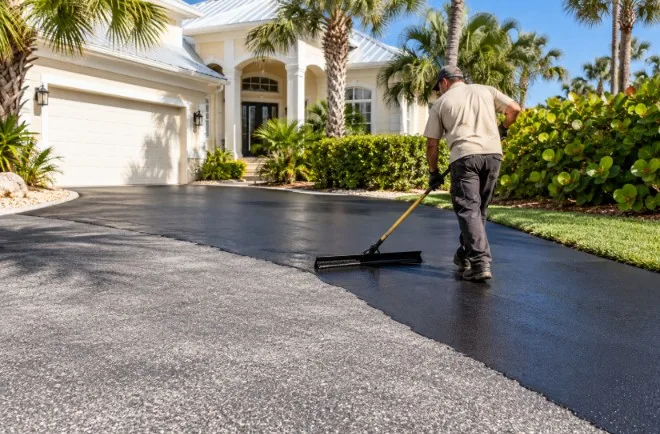
Most driveways in Central Florida do well with driveway sealcoating every two to three years. In Ormond Beach, where salt air speeds up the aging of asphalt, many driveways land closer to the two-year end, especially ones in full sun near the water.
That schedule is not one size fits all. Sun, traffic, and how your driveway was built all change the timing. The good news is that your driveway tells you when it is ready, if you know what to look for.
M&S Asphalt Paving seals driveways across Ormond Beach, Daytona Beach, DeLand, and the rest of Volusia County. If you want to know where your driveway stands, contact our team at (386) 215-7466 for a free estimate.
Why does Ormond Beach's coastal climate wear down asphalt faster?
Because sun, salt, and rain all go after the same thing: the binder that holds asphalt together. As that binder dries out and oxidizes, the surface turns brittle, fades, and starts to crack.
Salt air is the coastal twist. On the beachside, east of the Halifax River and along A1A, the breeze carries salt that settles on the pavement and speeds up oxidation. A driveway a few blocks from the ocean often ages faster than one of the same age farther inland.
Then there is the Florida sun, which bakes an unshaded driveway for most of the year, and the summer rainy season, when afternoon downpours roll through almost daily. Water that gets into small cracks works its way toward the base. Each of those forces is manageable on its own. Together, they are why coastal driveways need a steady maintenance plan.
A good sealcoat puts a protective layer between all of that and the asphalt underneath.
What are the signs it is time for driveway sealcoating?
Graying, fine surface cracks, and water that soaks in instead of beading up are the three clearest signs. If you see any of them, it is time to have the driveway looked at.
Graying comes first. Fresh asphalt is deep black. As the binder oxidizes, it fades to a dull gray, and you may start to see loose stones on the surface. That fading is the driveway telling you its protection is wearing thin.
Fine cracks come next. Thin, shallow lines, especially near the edges, are the early stage. Caught now, they are simple to fill. Left alone through a rainy season, they widen and let water reach the base.
For the water test, wait for a rain or spray a section with the hose. On a well-sealed driveway, water beads and runs off. When it darkens the surface and soaks in, the seal is gone. If a few years have passed since your last coat, even a driveway that looks fine deserves a check. We recommend an inspection at least every three years.
How does proper sealcoating timing extend the life of your pavement?
Sealing on schedule keeps small surface wear from turning into structural damage. A fresh coat costs a fraction of what repaving eventually does, and that is the whole value of staying on top of it.
Timing matters in both directions. Brand-new asphalt needs to cure for several months before its first sealcoat. After that, regular coats protect it from oxidation and water. Wait too long, and the cracks have already reached the base, where sealcoat cannot help.
Prep is half the job. We clear debris and vegetation, then fill every open crack before sealing, because sealcoat is a protective layer, not a crack filler. We also watch the forecast closely. A coat that gets hit by an afternoon storm before it sets will not bond properly, so we schedule around the weather. Most driveways are ready to drive on in about 24 hours.
Our driveway sealcoating page walks through that process step by step.
Should sealcoating be part of your home maintenance plan?
Yes. Your driveway is one of the largest surfaces on your property, and a simple schedule keeps it from becoming one of your most expensive repairs.
One of our Ormond Beach customers had a plan and a list for everything: changing air filters, maintaining water filters, keeping up with the chimney, you name it. But sealcoating the driveway was not on his list. He called us out, and we talked about adding driveway maintenance to his otherwise thorough list.
That is an easy fix for anyone. Note the date of your last sealcoat, plan the next one for two to three years out, and check the surface each spring before the rainy season. Whether you live off Granada Boulevard or out on the beachside, the routine is the same. For larger paved areas, our asphalt sealcoating service covers them too.
Ready to protect your driveway? Request a quote from M&S Asphalt Paving or call (386) 215-7466. We will inspect the surface and give you a straight price.