Repaving vs Resurfacing a DeLand Driveway: Which One Does Your Asphalt Need?
by Maria Santana · 4 min read
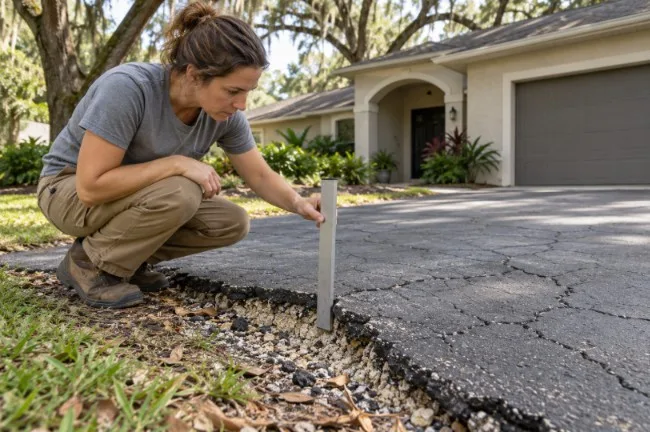
If the base under your asphalt is still solid, resurfacing is usually enough. If the base has failed, with deep cracks, sinking spots, or water that pools and stays, the driveway needs a full repave. Everything comes down to what is happening underneath the surface you can see.
That is why two driveways that look equally rough can need very different fixes. Fading and surface cracks are often cosmetic. Soft spots and spreading cracks usually are not.
M&S Asphalt Paving handles driveway paving for homeowners in DeLand and across Volusia County. If you want a real answer instead of a guess, contact our team at (386) 215-7466 for a free estimate.
How does a paving contractor check the base of a driveway?
By walking it, pressing on the weak areas, and looking for movement. A healthy base feels solid underfoot. A failing one shows up as dips, ruts where tires sit, and asphalt that flexes or breaks into small, connected pieces.
Those small, connected cracks are called alligator cracking, because the pattern looks like reptile skin. It almost always means the base has given way. Laying fresh asphalt over it only buys a short reprieve, because the same movement cracks the new layer from below.
DeLand's sandy soil plays a part here. Sand drains well, but when water gets under a driveway through open cracks, it can wash base material out and leave hollow spots. Under the shade of the big live oaks in neighborhoods near Stetson University, roots can also push up through a driveway and break the base in a line.
When we rebuild a base, we use crushed concrete or lime rock compacted in six-inch lifts, and we check it before any asphalt goes down.
What do crack depth and drainage tell you about your asphalt?
Shallow, thin cracks usually mean the surface is aging and can be filled or resurfaced. Wide or deep cracks, especially ones that keep growing, point to problems underneath. Drainage tells the rest of the story.
We look at how wide a crack is, whether the edges are crumbling, and whether we can see the base through it. A single crack across an otherwise solid driveway is a very different job from a web of cracks around a low spot.
Then we look at where the water goes. Volusia County's summer rainy season brings heavy afternoon downpours most days. If water sheets off your driveway toward the street, the surface has a fighting chance. If it collects in the same low spot after every storm, that water is soaking into the base, and resurfacing will not fix the slope.
Fixing drainage sometimes means regrading, which can only happen with a full repave.
How much do repaving and resurfacing cost, and how long do they last?
Resurfacing usually costs noticeably less because the existing base stays in place. A full repave costs more but resets the clock on the whole driveway, base included.
For a full replacement, NerdWallet's 2026 cost guide puts asphalt at roughly $7 to $15 per square foot, including labor. The same guide notes asphalt driveways can last 15 to 30 years, and periodic resurfacing helps extend that.
Where your driveway lands in those ranges depends on its size, how much base work is needed, and how easy it is to reach with equipment. A long rural drive outside town is a different job from a short driveway on a city lot.
Either way, maintenance protects the investment. We recommend a first sealcoat six to twelve months after new asphalt fully cures, then sealcoating on a regular schedule. Our driveway paving page explains how we build and care for each driveway.
Why should driveway paving start with an on-site assessment?
Because the deciding factors are under the surface. Photos show cracks and fading, but they cannot show whether the base is firm or whether water is getting underneath.
One homeowner told us his driveway had gotten so bad he no longer bothered to clean or sweep it. He had resigned himself to the cracks and uneven surfaces. When he finally called, he assumed he needed to start over. We checked it carefully so we could give him an honest assessment of whether repaving or resurfacing was the better course.
That is how every estimate should start. An honest assessment can save you from paying for a full repave you do not need, or from resurfacing a driveway that will crack again within a couple of years.
Take a look at our residential asphalt paving options, then request your free estimate or call (386) 215-7466. We are a local DeLand team, and we will tell you exactly what your driveway needs.