Your Driveway Is Three Years Old and Already Cracking. What Went Wrong?
by Hanna Carolina · 5 min read
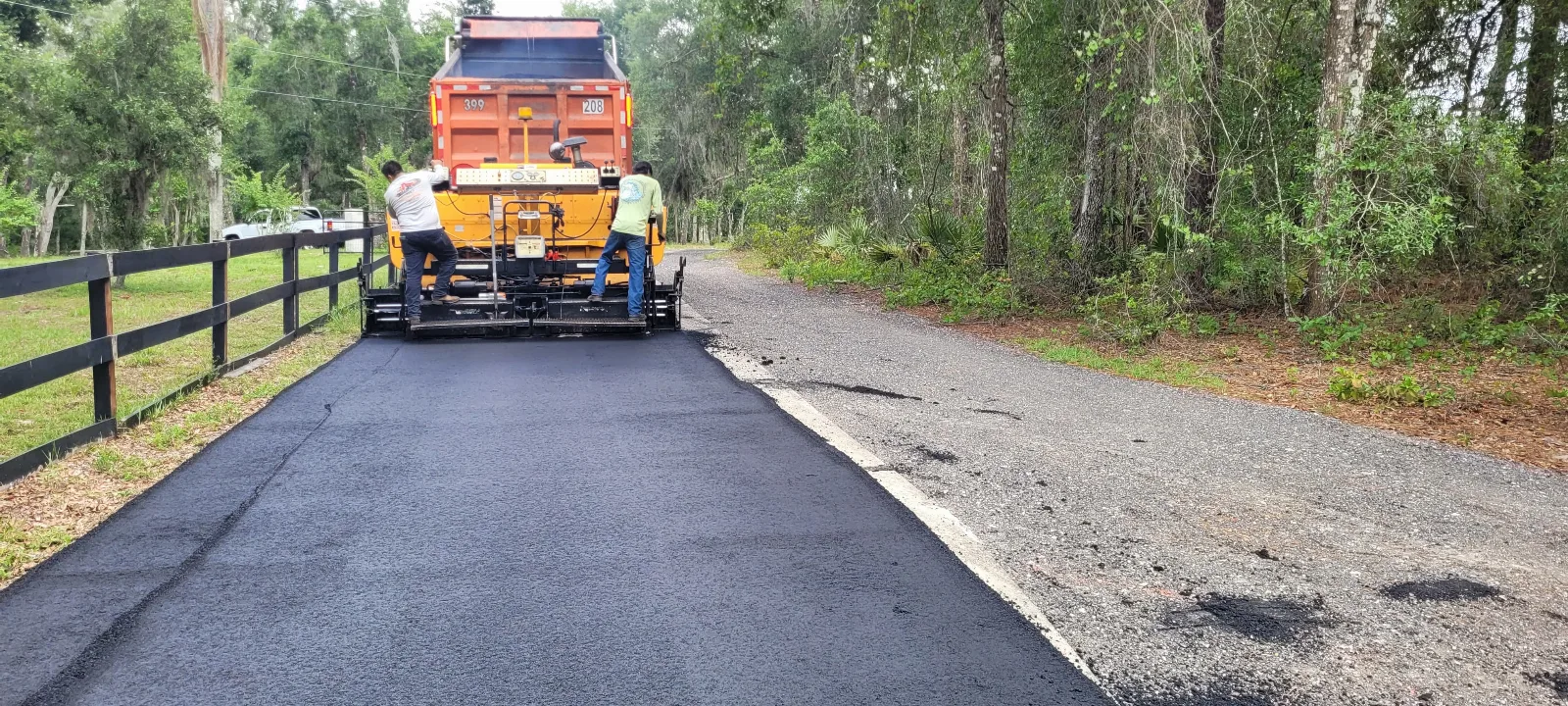
Almost always one of two shortcuts. Either there was no proper rock base under the asphalt, or the asphalt went down thinner than the quote said. Florida weather then finishes the job faster than it would anywhere further north. A driveway built correctly here runs ten to fifteen years, so three is not wear. It is a build problem.
That is worth knowing before you pay somebody to fix it, because the same shortcut done again gets you the same result. If you want an honest read on what happened to yours, reach out to our team or call (386) 215-7466. We will look at the cracks and tell you what they are telling us.
Was there a real base under your driveway?
This is the first thing to check and the most common thing to have been skipped. Asphalt does not carry weight on its own. Underneath it belongs a compacted road base, crushed concrete or lime rock, placed in layers with a roller run over each one. That base is what holds a car up. The asphalt is a wearing surface on top of it.
What some contractors do instead is lay asphalt straight onto dirt, or in the worst cases onto graded grass. It looks identical the day it is finished. Nobody can see two inches down. But sand under a Florida driveway moves, water travels through it after every storm, and asphalt with nothing solid beneath it flexes every time a vehicle rolls over the same spot. Flexing asphalt cracks.
You can often read it from the damage. Cracks that show up first in the wheel paths, where the tires actually track, point at the base rather than the surface. That is the pattern we see over and over on early failures around Volusia County. Our page on driveway paving sets out how the base gets built when it is done properly.
How thick was the asphalt actually laid?
A standard residential driveway should get two full inches after compaction. Not before. Loose asphalt loses a meaningful part of its height once the roller goes over it, so a crew that spreads two loose inches and calls the job finished has left you closer to an inch and a half. That gap is invisible on day one and decisive by year three.
Cutting depth is the easiest way to win a job on price, because it is the one thing a homeowner has no way to verify afterward. It is also why quotes for the same driveway can differ by so much. Juan does not do it. If we say two inches, that is what goes down, and if the driveway is taking a work truck or an RV it gets more than that.
If you still have the original quote, read what it said about depth. If the paperwork was vague on that point, or never mentioned it, you have most of your answer about why the surface is failing early.
How much of this is just Florida weather?
Weather is real, but it is an accelerant rather than a cause. Juan puts the early failures down to the weather together with the thickness the asphalt was laid at in the first place, and time. Sun bakes the binder that holds the surface together until it goes gray and brittle. Afternoon storms then push water into any crack that has opened.
A properly built driveway takes that same weather and lasts a decade or more. The difference is what is underneath and how thick the surface is. Heat and rain find the weak point in a surface, but they do not create one. That is why two driveways on the same street, poured in the same year, can be in completely different condition.
Sealing on a sensible cycle slows the process down further, which is what driveway sealcoating is for. It will not rescue a driveway with no base under it, though. Sealer protects a surface, it does not support one.
Can it be repaired, or does it have to come out?
It depends on how far the cracking has spread. Isolated damage over a base that is still sound can be cut out, the failed material dug away, new base compacted in six inch lifts, and two inches of asphalt put back. That is a real repair and it holds. Where the cracking has spread into a web across most of the driveway, the surface comes out and gets replaced.
The threshold we use is alligator cracking wider than about a quarter of an inch, spread across the area rather than in one patch. Under that, crack filling and asphalt repairs is usually the cheaper and honest answer, and we will tell you so instead of quoting a replacement.
At M&S Asphalt Paving Juan has twenty two years in asphalt behind him, including DOT road work, where base depth and compaction get inspected rather than trusted. If you want to know which of the two your driveway needs, get in touch here or call (386) 215-7466. Estimates are free, they usually go out same day or next, and we speak English and Spanish.