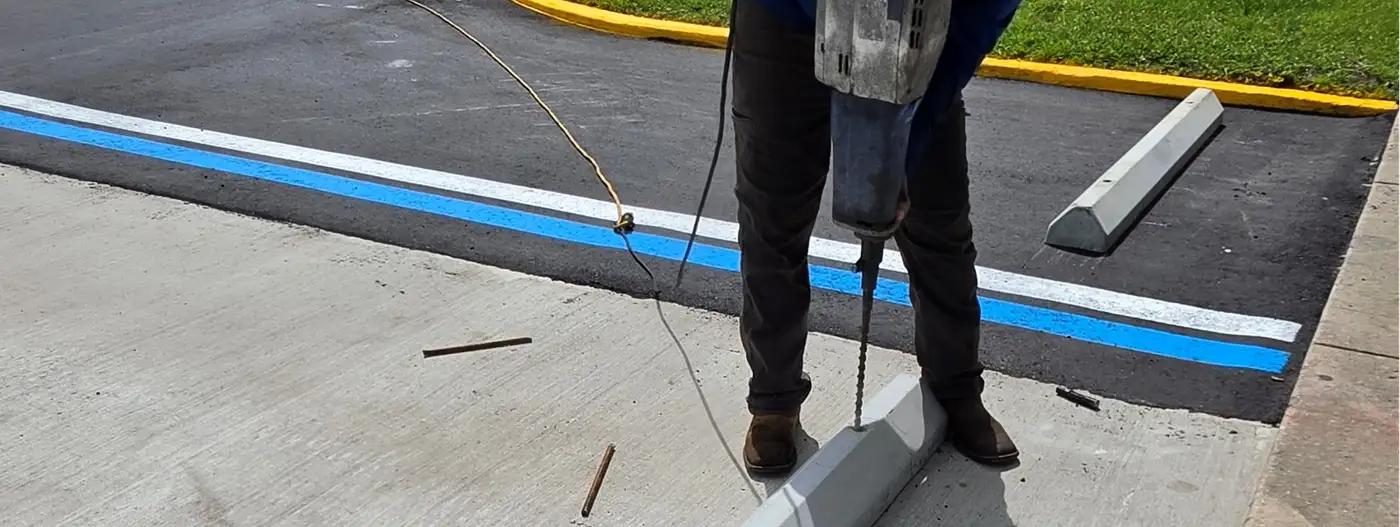
Curb Stop Installationin DeLand, Florida
Curb stops are the last physical layer of a well-organized parking lot. Striping defines the stalls. Curb stops reinforce where vehicles stop, protect the landscaping, sidewalks, and structures behind them, and keep the lot working the way it was laid out. M&S Asphalt Paving installs, replaces, and repositions concrete and rubber curb stops across Volusia County for commercial properties, retail centers, HOA parking areas, and any lot that needs its stops sorted out properly.

What Curb Stops Actually Do
Why does a parking lot need curb stops?
A curb stop does one job: it tells a vehicle where to stop. That sounds straightforward until you look at a lot where the stops are missing, broken, or placed wrong. Without them, vehicles overrun stalls and damage landscaping beds, light poles, dumpster enclosures, and building facades. A front bumper can do real damage to a curb or a storefront in a slow parking maneuver if there is nothing stopping it short.
Beyond property protection, curb stops are a safety element. They keep vehicles out of pedestrian walkways at the stall end of a lot row, and they help drivers judge their position without needing to look behind. In a well-laid-out lot, a driver backs in, feels the rear tires contact the stop, and knows they are correctly parked without guessing. That predictability reduces fender contact between adjacent vehicles and keeps pedestrian zones clear.
There is also a liability dimension. A commercial property owner whose lot has missing or displaced curb stops and a pattern of vehicle-pedestrian proximity incidents has a harder conversation with their insurer than one whose lot is maintained and marked correctly. Curb stops are inexpensive. The problems they prevent are not. We pair curb stop work with commercial lot maintenance whenever a property walk turns up stops that need attention.
New Installation
Full curb stop layout for a new or resurfaced lot. We set stops at the correct depth from the front of each stall, anchored with rebar pins through the asphalt, across every row in the lot.
Replacement of Broken Stops
Cracked, tipped, and missing stops are pulled out and replaced with new concrete or rubber stops. Damaged pavement under them is repaired first so the new stop sits flat and holds its anchors.
Repositioning and Realignment
Stops that have shifted, rotated, or been pushed out of position, common in lots that get plowed or pressure-washed, are pulled up and reset in the correct position with fresh anchors.
Missing Stop Surveys
For lots where stops have been removed or were never installed, we walk the property, count the positions, and quote the full install. Common after a sealcoating job where old stops were pulled and not replaced.
ADA Clearance Verification
Curb stops in accessible spaces and access aisles require specific placement, or no stop at all in the aisle itself. We confirm correct positioning relative to accessible space markings when installing in ADA designated areas.

Choosing the Right Stop
Concrete or rubber curb stops, which is right for your lot?
Both materials work. The right choice depends on the lot surface, the traffic load, the exposure conditions, and whether the stops will be moved for maintenance. Concrete is heavier, more durable under sustained impact, and holds its position well in a fixed lot. Rubber is lighter, easier to handle during resurfacing or power washing, and recovers from glancing impacts without cracking. We use both and will tell you which makes more sense for your specific property.
Standard
Concrete Curb Stops
Precast concrete stops are the default for commercial lots that stay in place year-round. They are heavy enough that a vehicle strike does not easily move them even when an anchor pin is loose or damaged. The weight works in their favor: a concrete stop that shifts still provides some resistance, while a rubber stop in the same situation slides easily. In Florida's heat, concrete holds its shape without softening, and it does not degrade from UV exposure the way some rubber compounds do over time.
- Typically 6 feet long, 6 inches wide, 4 to 5 inches tall
- Anchored with two rebar pins into the asphalt base
- Available in standard grey; painted yellow on request
- Best for fixed commercial lots, retail centers, and HOA parking
- Heavier to handle during resurfacing, so stops are typically removed and reset
Alternative
Rubber Curb Stops
Recycled rubber stops are a practical choice where the lot gets regular maintenance that requires moving them: power washing, resurfacing, seasonal restriping. They are light enough for one person to lift and reposition without equipment. They also absorb impact differently than concrete. A slow vehicle strike that would chip or crack a concrete stop may leave a rubber stop undamaged, making them useful in tight lots where slow-speed contact is more common. UV degradation is the main limitation; rubber stops in direct Florida sun have a shorter service life than concrete and may need replacement every few years rather than decades.
- Typically 6 feet long, lightweight, around 20 to 25 lbs
- Anchored with spikes through predrilled holes
- Yellow reflective strips standard on most products
- Best for lots with frequent resurfacing or mobile setups
- Shorter service life in sustained UV, so inspect annually
Getting Placement Right
Where should curb stops be placed in a parking stall?
The position of a curb stop within a stall matters more than most property managers realize. Set too far forward, a stop leaves vehicles overhanging the sidewalk or landscaping beyond it. Set too far back, the stop ends up under the car rather than in front of the front wheels, which means it does nothing to prevent overhang and becomes a tripping hazard for pedestrians walking between cars.
The standard placement positions the stop so the front face sits approximately 2 feet from the front end of the parking stall, measured from the stall line. That positions the stop to catch the front tire before the bumper and front of the vehicle reach the landscaping, sidewalk, or structure behind it. For compact car stalls or tight lots, this measurement adjusts.
Alignment matters across an entire row as well. Stops that are angled, staggered at different depths, or placed inconsistently from stall to stall make the lot look unmaintained and can cause drivers to misjudge their position. We set stops in a continuous, consistent line across each row so the lot functions and reads as an organized space. That consistency is part of what we check when we pair curb stop work with a lot sealcoating and restriping job.
Standard Stalls
Full-Size and Compact Spaces
Stop placed 2 feet back from the stall end line, centered in the stall width. Anchored with two rebar pins, stops level and aligned in a continuous row. Gap at each stall edge allows drainage and prevents asphalt heaving under the stop over time.
ADA Accessible Spaces
Accessible Stalls and Access Aisles
Concrete stops may be placed at the vehicle end of an accessible parking space, but never in the adjacent access aisle. The aisle must remain clear for ramp deployment and wheelchair transfer. We verify ADA stall geometry before placement and flag any conflicts with existing striping.
EV and Loading Zones
Electric Vehicle and Restricted Spaces
EV charging stalls with in-ground equipment, loading zones with pallet jack traffic, and stalls adjacent to fire lanes all have placement considerations beyond the standard two-foot rule. We assess each location before setting stops so the stop does not obstruct the function of the space.
Use Caution
Stalls Abutting Drainage Features
Curb stops placed directly over or immediately beside lot drainage inlets can redirect water and block flow. In lots with surface drainage issues, we mark these positions and discuss options before installation. A stop that creates a drainage problem costs more to fix than the stop itself.
Knowing When to Act
When do curb stops need to be replaced or reset?
Most property managers do not walk their parking lots looking at curb stops until something goes wrong. A vehicle hits a building corner, a landscaping bed gets driven through, a tenant complains about a stop that moved into the walking path. By then the damage is done. A quick survey of the lot's stops during a regular maintenance visit catches these problems before they become incidents.
Curb stops fail in a small number of predictable ways. Concrete stops crack from direct vehicle impact, usually from a driver pulling in too fast or at an angle. Stops of both materials shift or rotate when anchor pins corrode and lose their grip in the asphalt, which happens in lots that flood regularly or have poor base drainage. Stops disappear entirely after sealcoating jobs where a contractor removes them and does not reinstall them, a surprisingly common situation that we see on property inspections.
The signals listed here are the ones worth acting on promptly. A lot where several of these conditions exist at once is a lot where something preventable is likely to happen soon. If a sealcoating or restriping project is coming up, the right time to address the curb stops is during that same visit, while the lot is already cleared of vehicles and the crew is on property.

Cracked or Shattered Concrete
A concrete stop that has split or lost a section no longer stops a vehicle at the correct point. What remains may also be a trip hazard at tire height for pedestrians walking the stall row.
Stop Rotated or Angled in the Stall
A stop that has rotated 30 or 45 degrees is no longer blocking the full width of the stall. Vehicles can pull past it on one side, and the exposed corner becomes a tire-scraping hazard for adjacent parkers.
Stop Pushed Back Into the Stall
When a stop has shifted toward the back of the stall, it is now under vehicles rather than in front of them. It provides no overhang protection and sits where pedestrians walking between cars are most likely to step on it.
Missing Stops in One or More Rows
A full row with no stops, common after a sealcoating job where stops were removed and not reinstalled, leaves the landscaping, sidewalk, or structure at the end of that row unprotected. All it takes is one inattentive driver.
Rubber Stops Degraded or Flattened
Rubber stops exposed to sustained Florida UV develop surface cracking and eventually flatten under repeated vehicle contact. A rubber stop that compresses under a tire is no longer providing the height needed to register as a physical stop to the driver.
Anchor Pins Corroded or Pulled Loose
A stop that rocks or lifts at one end has a failed pin. The stop may look intact but will shift under the next impact. Corroded pins in Florida's humidity are common in older lots and in any lot that pools water regularly.
Part of the Bigger Picture
Curb stops work best alongside the rest of your lot maintenance
A curb stop is one piece of a lot's physical organization. Striping defines the stalls. Sealcoating protects the surface. ADA layout ensures compliance. Curb stops enforce where vehicles stop within that system. When any of these layers is missing or in poor condition, the rest work less well. The most efficient time to address curb stops is when other lot work is already underway, because the lot is cleared of vehicles and the same crew is already on site.
Parking Lot Striping and Layout
We lay out stall lines, directional arrows, fire lanes, and ADA spaces. Curb stop installation follows the striping layout so stops are positioned correctly relative to stall geometry and access aisle clearances.
Lot Sealcoating
Sealcoating requires removing curb stops so the sealer covers the full surface underneath them. We remove, seal, restripe, and reinstall or replace stops in one coordinated visit rather than leaving stops out or returning for a second trip.
Concrete Curbs and ADA Work
Perimeter curbs, curb ramps, and ADA landing pads are a separate scope from parking lot curb stops (see our concrete services) but are often needed at the same time. We handle both and can assess the full lot perimeter as part of the same estimate visit.
Where We Work
Where does M&S Asphalt Paving work?
We are based in DeLand and work across Volusia and Seminole counties and the north Orlando area. Being local matters more than it sounds. We know how the sandy soil around here behaves under a base, how the salt air near the coast speeds up oxidation, and how much afternoon rain a fresh sealcoat has to dodge in summer. When you hire a crew that drives these roads every day, you get someone who can be on site quickly and who is easy to reach afterward under the warranty.
Your town not listed? Call us at (386) 215-7466. We travel for the right project.
Need curb stops installed, replaced, or sorted out?
Call and tell us what the lot looks like: missing stops, broken stops, a full install after sealcoating, or a lot you have not looked at closely in a while. We will come out, walk the property, and give you a count and a quote. Most estimates go out same day or next day. Curb stop work is typically done as a standalone visit or alongside sealcoating and restriping.
Call us today (386) 215-7466