Concrete Servicesin DeLand, Florida
Most of what we do with concrete starts the same way asphalt does: compacted base, proper grade, thickness at spec. The foundation discipline is identical. Where they differ is in finish life, surface cost, and which application calls for which material. M&S Asphalt Paving handles concrete driveways and parking areas, sidewalks and walkways, curbs and curb stops, ADA concrete work, and repairs across DeLand and Volusia County. Licensed, insured, and BBB accredited.

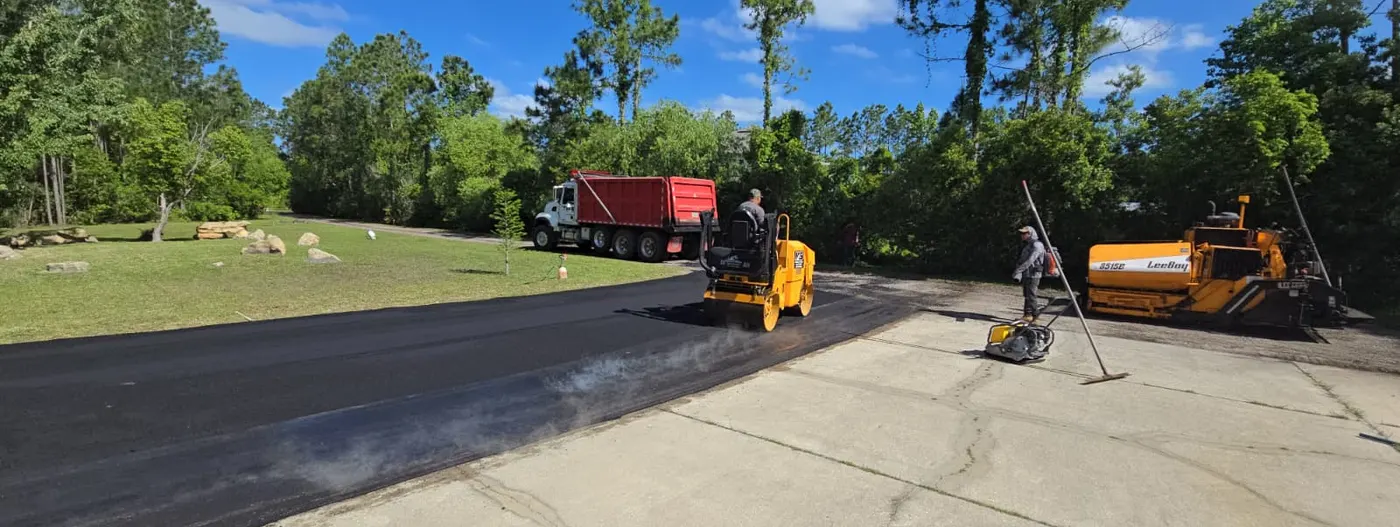
During paving
What We Build and Repair
What concrete services does M&S offer across DeLand and Volusia County?
Whether the job is a new concrete driveway, a broken sidewalk panel, a commercial curb replacement, or ADA accessibility work, the starting point is the same as any paving project: the right base, the right grade, and the right thickness for what the surface will carry. We handle residential and commercial concrete work across the region and give free estimates for all of it.
Concrete Driveways
Concrete driveways last 25 to 30 years when they are poured on a proper compacted base at the right thickness and given time to cure. In DeLand's sandy soil, that base is the critical investment, the same requirement that applies to asphalt. A slab poured thin on bare dirt will crack and heave within a few seasons regardless of how well the concrete itself was mixed.
Sidewalks and Walkways
Sidewalks and walkways fail at the joints and at root-lifted sections more often than anywhere else. We replace individual panels that have cracked or heaved, repour whole runs, and build new walkways from scratch for commercial properties and residential lots that need a graded, safe path from parking to entrance.
Curbs and Curb Stops
Concrete curbs define lot edges, control drainage, and keep vehicles off landscaping and pedestrian paths. Curb stops protect storefronts and loading areas from parking damage. Both take hits and eventually need replacement. We form and pour new curb sections, replace damaged runs, and handle curb stop installation at the right height for the parking geometry of the lot.
Choosing the Right Material
When should you choose concrete over asphalt?
Both materials work in Central Florida when they are built correctly. The choice comes down to what the surface needs to do, how long it needs to last, what the budget looks like upfront versus over time, and whether the application has requirements, like ADA compliance or specific load ratings, that favor one material.
Concrete costs more to install but lasts significantly longer without the recurring maintenance cost of sealcoating. It also handles Florida's heat better in some applications. It does not soften the way asphalt can under sustained high temperatures, which matters for surfaces that sit in direct sun all day under heavy stationary loads like loaded delivery vehicles. For sidewalks, curbs, and ADA ramps, concrete is the standard material and the right choice in almost every case.
Asphalt is the practical answer for large surfaces where speed and cost matter: big parking lots, roadways, and driveways where the sealcoating cost over 15 years is acceptable. We work with both and will tell you which one makes more sense for your specific project after looking at it. There is no advantage to us in steering you toward the more expensive option if the cheaper one does the job.
Sidewalks and Walkways
Standard material for pedestrian paths. Longevity and a maintenance free surface outweigh the higher upfront cost over the life of a walkway.
ADA Ramps and Landing Pads
Required in most applications. Concrete holds slope and surface texture better than asphalt over time, and detectable warning tiles install cleanly into a concrete finish.
Curbs, Curb Stops, and Wheel Stops
Concrete is the standard for curb and gutter work. It is more durable at the edge than asphalt and holds its profile under vehicle impact.
Loading Dock Aprons and Dumpster Pads
Heavy concentrated loads in small areas are best handled by concrete at full commercial thickness. Asphalt in those spots needs frequent repair.
Large Parking Lots and Driveways
Lower install cost, faster return to use after paving, and easier to repair in sections. The right call when the surface area is large and the budget favors the lower upfront number.
Residential Driveways
Depends on budget, preference, and lot conditions. Concrete lasts longer with lower maintenance. Asphalt costs less to install. We will give you the honest comparison for your specific driveway before you decide.
ADA Concrete Standards
What makes concrete ADA compliant?
ADA compliance in concrete work is about dimensions, slopes, and surfaces. All three have to be right or the work does not meet the standard. A ramp built at the wrong slope, a landing that is too small, or a pad without the correct detectable warning surface each represents a real compliance failure, not a cosmetic issue. For commercial property owners, non-compliant accessible routes carry legal exposure and affect who can safely reach the building.
We build ADA concrete work to the current standard rather than guessing. Ramp slopes stay within the 1:12 maximum, and often shallower where the grade allows. Landings at the top and bottom of every ramp meet the minimum 5 foot by 5 foot dimension. Cross slopes on accessible routes stay at or below 2 percent. Detectable warning surfaces go in correctly: the right tile, the right color, the right placement at curb transitions.
For commercial properties doing sealcoating and restriping through our commercial asphalt service, we commonly pair that work with a review of accessible spaces and curb ramps. If a ramp is out of spec or a landing has settled out of slope, it makes sense to correct it while the lot work is already underway. We will point it out as part of the estimate rather than let it go unmentioned.
ADA work does not self-certify. If you are not sure whether existing ramps and routes on your property meet current requirements, the estimate call is a good time to ask. We will look at what is there and give you a straight read before any work starts.

Ramp Slope: 1:12 Maximum
For every 12 inches of horizontal run, the rise cannot exceed 1 inch. Shallower is better where the grade allows it.
Landing Dimensions: 5 ft by 5 ft Minimum
Landings at the top and bottom of every ramp, and at any change of direction, must give a wheelchair enough space to maneuver and pause safely.
Cross Slope: 2% Maximum
Accessible routes cannot slope more than 2 percent perpendicular to the direction of travel. A surface that drains well but exceeds this cross slope fails the standard.
Detectable Warning Surfaces
Truncated dome tiles in a contrasting color at the base of every curb ramp, flush with the roadway surface. Placement, size, and color are specified, not optional.
Ramp Width: 36 Inches Minimum
The clear width of the ramp surface between the curb or edge protection must be at least 36 inches. Most commercial ramps are built wider to allow easier two way passage.
Accessible Route to Building Entry
The entire path from accessible parking to the building entrance, including the ramp, landing, and any walkway, must meet accessible route standards end to end, not just at the ramp.

When Concrete Fails
How do we approach concrete repairs?
Concrete cracks for reasons: tree roots, joint failure, base settlement, and simple age. Understanding why a section failed before we repour it is the difference between a repair that lasts and one that repeats itself. We assess the cause before quoting a fix, because a slab repoured over an active root system or a settled base will fail again in the same spot. That is a waste of the homeowner's money and ours.
Root-Lifted Panels
Tree roots lift concrete panels from below, creating trip hazards and drainage problems. The right fix depends on the root situation. Sometimes the panel is removed, the root is cut below the slab depth, and a root barrier goes in before repour. Sometimes grinding the lifted edge is enough for a short term fix. We tell you which applies before any concrete is broken out.
Cracked and Settled Slabs
Slabs that have cracked through and settled, particularly in low lying areas near Volusia County drainage features, have base movement underneath them. We remove the slab, compact the sub-base material in the void, and repour at spec. Patching over a settled slab without addressing the sub-base repeats the failure on the same timeline.
Spalled and Deteriorated Surfaces
Surface spalling, where the top layer flakes or pits, is usually a curing or finishing issue on the original pour, accelerated by Florida's UV and seasonal rain. Minor spalling can be addressed with a surface repair. Widespread spalling on an older slab often means replacement is the more cost effective path. We look at the depth and extent before recommending either.
Joint Failure and Resealing
Expansion and control joints let concrete move without cracking. When joint sealant dries out, shrinks, or is missing, water gets in and the wet and dry cycle does the rest. We clean failed joints and reseal them, and where joints were placed incorrectly or not at all in an old pour, we saw cut and fill. Getting the joints right is cheaper than cracking the slab.
The Same Foundation Discipline
What does M&S bring to concrete work from its asphalt experience?
Concrete and asphalt share the same foundation requirement: a compacted base that carries load without shifting. M&S has been building that base, crushed concrete and lime rock compacted in lifts, for over 20 years on asphalt projects across Volusia County. That discipline carries directly into concrete work, and it is the same road base construction we do before any paving job. When we pour a driveway or a commercial loading pad, the base underneath it is graded for drainage, compacted to spec, and checked before any material goes on top.
The visible finish work differs between the two materials, but the thinking underneath does not. Concrete cracks when the base settles. It holds when the base holds. In DeLand's sandy soil, this is not an academic point. It is the single variable that separates a concrete driveway that lasts 30 years from one that is cracked and heaved in five. We take the same care with it in concrete work that we do in driveway paving.
Grade and Compact the Sub-Base
Area excavated to proper depth, sub-base graded for drainage, and compacted in lifts. In Volusia County's sandy soil, this step determines the outcome more than any other.
Form and Reinforce
Forms set to the correct dimensions and slope. Steel rebar or wire mesh placed where the application requires it. Driveways, commercial flatwork, and loading areas all get reinforcement appropriate to their load.
Pour and Finish
Concrete poured, screeded, and finished to the specified texture. Expansion joints cut or placed at correct intervals before the slab sets. Broom finish is standard for driveways and walkways, and other finishes are available on request.
Cure and Hand Off
Concrete covered and kept moist during the cure period, which is critical in Florida heat. We give you a clear timeline for foot traffic and vehicle return before we leave, not an estimate after the fact.
Where We Work
Where does M&S Asphalt Paving work?
We are based in DeLand and work across Volusia and Seminole counties and the north Orlando area. Being local matters more than it sounds. We know how the sandy soil around here behaves under a base, how the salt air near the coast speeds up oxidation, and how much afternoon rain a fresh sealcoat has to dodge in summer. When you hire a crew that drives these roads every day, you get someone who can be on site quickly and who is easy to reach afterward under the warranty.
Your town not listed? Call us at (386) 215-7466. We travel for the right project.
Concrete work in DeLand or Volusia County?
Call and describe the project. A new concrete driveway, a sidewalk panel that needs replacing, ADA ramp work, commercial flatwork, or a cracked slab you are not sure about. We will come out, look at it, tell you honestly what it needs, and quote the right job. Most estimates go out same day or next day.
Call us today (386) 215-7466