Recycled Asphalt Millingsin DeLand, Florida
Recycled asphalt millings are ground-up pavement from mill and overlay jobs, the same material we collect from our own commercial resurfacing projects. When graded and compacted properly, millings bind together and form a durable, low dust surface that works well for driveways, private roads, parking areas, and access roads where a full asphalt pour is not the right fit. M&S Asphalt Paving supplies, delivers, grades, spreads, and compacts millings across Volusia County. We also tell you honestly when millings are the smart choice and when they are not.

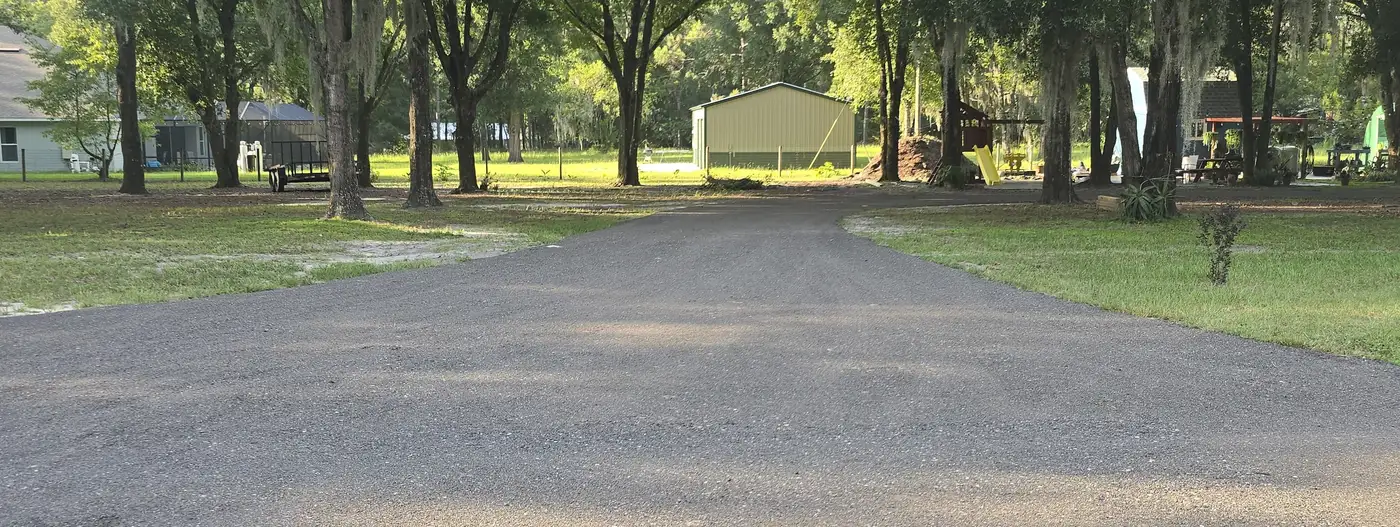
Sub-grade before millings
What Recycled Asphalt Millings Are
What are asphalt millings and where do they come from?
Asphalt millings are the material produced when a paving crew mills the surface of an old road or parking lot before resurfacing it. A milling machine grinds the top layer of existing pavement down to a specific depth, collecting the ground-up asphalt as it goes. That material, mixed aggregate and asphalt binder, is what millings are. They are not waste. They are a usable surface material with real residual binding strength.
M&S produces millings directly from our own mill and overlay jobs and sources additional material as needed. Because we work with millings on both ends, as a production by-product and as an installed surface, we understand what quality millings look like and what bad ones do to a finished job. Millings with too much fines (dust-sized particles) drain poorly and stay soft. Millings with good gradation compact well, bind on their own in Florida heat, and hold up to vehicle traffic when the base underneath them is solid.
The key distinction between millings installed correctly and millings dumped and left: compaction. Without a roller, a millings surface stays loose, tracks into vehicles and structures, and does not bind. With proper grading and compaction, millings firm up and behave much closer to a paved surface than to gravel.
Residential Driveways
Cost-effective surface for long rural driveways, secondary drives to garages or barns, and properties where a full asphalt pour is more than the application needs.
Private and Farm Roads
Rural access roads, farm lanes, and private roads where gravel is too dusty and full asphalt is not justified by traffic volume or budget. Millings handle moderate vehicle and equipment loads well.
Parking and Staging Areas
Employee and overflow parking, equipment staging areas, temporary event parking, and utility yards where a low cost firm surface is needed without permanent pavement.
Access and Service Roads
Utility access roads, construction site entry roads, and property access lanes that need a durable surface for occasional or seasonal use without the cost of permanent paving.

Why Millings Work in Florida
What makes recycled asphalt millings a practical surface choice?
Millings have four properties that make them useful: cost, durability when compacted, self-binding in heat, and drainage. In Central Florida's climate, the heat advantage is particularly relevant. The residual asphalt binder in millings softens slightly in summer sun and then re-hardens, which means the surface firms up over time rather than loosening. That is the opposite of what gravel does.
01
Cost: A Fraction of Full Asphalt
Millings cost significantly less than new hot-mix asphalt per square foot installed. For large surfaces like long driveways, farm roads, and parking areas, the savings are meaningful without sacrificing a usable, firm surface.
The cost comparison matters most for applications where traffic is light to moderate and a surface with a 10 year life is not needed. For a rural driveway with occasional passenger cars and a pickup truck, millings compacted properly will last years without the investment a full pour would require. For a primary driveway in a residential neighborhood, full asphalt is usually the better long-term answer.
02
Self-Binding in Florida Heat
The residual asphalt binder in millings activates in summer heat and causes particles to knit together. A properly compacted millings surface firms up over its first few warm seasons rather than staying loose.
This is what separates millings from gravel in Florida's climate specifically. Gravel stays gravel: individual stones that migrate, track into buildings, and resist compaction indefinitely. Millings behave differently because the binder is already mixed in. The heat does the same thing it does in the initial laying of hot-mix: it softens the binder and lets particles bind. The result is a surface that becomes more stable over time.
03
Low Dust After Compaction
Gravel generates dust and noise. Millings, once compacted, suppress dust significantly better because the binder holds fine particles in place rather than letting them become airborne.
Dust control matters for driveways next to structures, farm lanes near crops or equipment, and any surface used regularly where tracking fine material into buildings is a maintenance burden. It is also a reason millings work better than crushed limestone or shell rock in applications near homes and businesses.
04
Drainage Through the Surface
Millings drain water through the surface and into the sub-base rather than shedding it sideways like sealed pavement. In areas with drainage constraints, this is an advantage.
For properties in low-lying parts of Volusia County, pervious drainage is sometimes preferable to a sealed surface that directs all water to one edge. Millings allow infiltration while still providing a firm surface for vehicles. The base underneath needs to be graded for drainage all the same. Millings that sit in standing water erode just like any other unpaved surface.
How We Grade, Spread, and Compact
What does a millings installation actually involve?
The difference between millings that hold up and millings that turn into a muddy, rutted surface within a season is almost entirely the installation. Material dumped from a truck without grading or compaction does not perform. That is what gives millings a bad reputation in some applications. It is not the material itself, but skipping the steps that make it work.
We approach a millings job with the same road base construction discipline we apply to asphalt: the ground underneath matters as much as what goes on top. If the sub-grade is soft, wet, or poorly drained, millings on top of it will fail. The prep work is not optional. It is what separates a millings surface that lasts from one that becomes a maintenance problem.
We also offer delivery only if the customer has their own equipment to grade and compact. But for most residential and commercial applications, having us handle the full installation (supply, delivery, grading, and compaction) produces a result the customer can actually drive on without ruts and soft spots appearing after the first rain. Call us and describe the project. We can talk through whether delivery only or full installation is the right scope for your situation.
Site Assessment and Sub-Grade Prep
Area inspected for soft spots, low points, and drainage direction. Any vegetation cleared. Sub-grade graded and compacted where needed. Millings placed on soft or wet ground will rut under traffic regardless of how well they are installed.
Delivery and Spread
Millings delivered and spread to a consistent depth, typically 4 to 6 inches for a driveway or access road, adjusted based on traffic load and the condition of the sub-grade. Spread evenly across the full width of the intended surface.
Grade for Drainage
Surface graded for the correct crown or cross-slope so water sheds to the sides rather than pooling on the driving surface. A millings surface with flat or inverted grade holds water and softens. Grade is set before compaction, not after.
Compaction
Surface rolled in passes with a drum roller. Compaction is what converts spread millings into a bound surface. Without it, millings stay loose and track. Multiple roller passes at the correct weight bring the surface to a density that holds vehicle traffic and allows the binder to begin knitting particles together.
Surface Inspection and Handoff
Final check for low spots, drainage issues, and loose edges before we leave. You get a clear picture of what to expect in the first few weeks. Some surface loosening during the initial cure period is normal and expected before heat binding takes hold.
Comparing Your Options
How do millings compare to gravel and traditional asphalt?
The honest answer is that each material has applications where it makes more sense than the others. Millings are not always the right choice, and we will say so when they are not. This comparison covers the practical differences for the kinds of surfaces our customers actually call about.
| Attribute | Recycled Millings | Gravel / Crushed Stone | Hot-Mix Asphalt |
|---|---|---|---|
| Install Cost | Low, significantly less than asphalt | Low, similar to millings upfront | Higher upfront, longer surface life |
| Dust | Low after compaction, binder holds fines | High, loose particles stay loose | None, sealed surface |
| Surface Stability | Good after compaction, improves with heat | Shifts and migrates under traffic | Excellent, hard stable sealed surface |
| Drainage | Pervious, water infiltrates through surface | Pervious, drains through but erodes easily | Impervious, water sheds to edges or drains |
| Maintenance | Low, occasional top-dressing and no sealcoat needed | High, regular redistribution and material added over time | Low ongoing, sealcoat every 2 to 3 years |
| Best Application | Rural driveways, access roads, overflow parking, farm lanes | Temporary lanes and low use areas | Primary driveways, commercial lots, high traffic surfaces |
| Florida Heat Performance | Improves, binder activates and firms up the surface | No change, stays loose regardless of temperature | Stable, minor softening in extreme heat that fully recovers |
Material That Comes Full Circle
What makes recycled asphalt millings an environmentally responsible choice?
Millings are reclaimed material. When we mill an old parking lot or road surface for resurfacing, the ground-up asphalt that comes off the pavement milling machine is a finished material ready to be reused. Nothing has to be manufactured, quarried, or shipped from a processing facility. The binder is already in the material. The aggregate is already graded. It simply needs to be collected, transported to the next job, and installed.
That reclamation loop is the environmental case for millings. Using them instead of new aggregate like crushed stone or shell rock avoids the quarrying and transport energy those materials require. Using them instead of a full new asphalt pour avoids the manufacturing energy of producing fresh hot-mix. A millings surface is, in practical terms, a closed-loop material in the paving world.
For property owners who want a usable firm surface without the full environmental and cost footprint of new pavement, millings are the most straightforward option on the market. They work best when installed correctly, which is the same standard that applies to every paving material we work with.
Reclaimed
No New Material Manufactured
Millings come directly from milled road and lot surfaces. The aggregate and binder are already processed, with no new quarrying and no new asphalt plant energy input for the surface material itself.
Low Embodied Energy
Fraction of New Asphalt's Footprint
New hot-mix asphalt requires heating aggregate and liquid asphalt binder to 300+ degrees Fahrenheit. Recycled millings skip that manufacturing step entirely.
Diverted from Landfill
Material That Would Otherwise Be Disposed Of
When a paving crew mills a lot surface, the millings have to go somewhere. Using them as a finished surface product keeps that material in service rather than disposing of it.
Pervious
Allows Groundwater Recharge
Millings allow rain to infiltrate through the surface and into the soil below, supporting groundwater recharge rather than routing all runoff to drainage infrastructure as sealed pavement does.
The Honest Read
When are millings the right choice, and when are they not?
We would rather give you a straight read on this than oversell a product that is not the best fit for your specific situation. Millings work very well in certain applications and poorly in others. The application, the traffic load, the drainage conditions, and the long-term expectations for the surface all factor into whether millings are the right answer.
For a long rural driveway, a farm access road, or an overflow parking area, millings are often the best value available: durable, low maintenance, low dust, and significantly cheaper than full asphalt. For a primary residential driveway in an established neighborhood or a commercial lot with heavy daily traffic, full driveway paving with asphalt gives a longer-lived, lower maintenance surface that is worth the additional upfront cost. We will tell you which applies when we look at the project.
One situation where millings make particular sense in Volusia County: properties that need a firm, passable surface quickly and within a tight budget. Millings can go in on a graded sub-grade in a single day for most residential and light commercial applications, and they are usable immediately after compaction without a curing period.
Millings Are a Good Fit
These applications work well
- Rural driveways over 100 feet where asphalt cost is hard to justify
- Farm and agricultural access lanes with light to moderate vehicle traffic
- Overflow and secondary parking on properties with established paved primary areas
- Construction and utility access roads, temporary or semi-permanent
- Properties needing a usable surface quickly and within a tight budget
- Areas where permeability is preferred over sealed runoff
Consider Full Asphalt Instead
These applications call for more
- Primary residential driveways in established neighborhoods
- Commercial lots with daily heavy vehicle traffic
- High curb appeal applications where appearance matters long term
- Surfaces adjacent to structures where tracking material inside is a concern
- Areas with very poor drainage and no practical way to improve sub-grade
- Projects requiring a sealed, ADA compliant, or striped surface
Where We Work
Where does M&S Asphalt Paving work?
We are based in DeLand and work across Volusia and Seminole counties and the north Orlando area. Being local matters more than it sounds. We know how the sandy soil around here behaves under a base, how the salt air near the coast speeds up oxidation, and how much afternoon rain a fresh sealcoat has to dodge in summer. When you hire a crew that drives these roads every day, you get someone who can be on site quickly and who is easy to reach afterward under the warranty.
Your town not listed? Call us at (386) 215-7466. We travel for the right project.
Millings in DeLand or Volusia County?
Call and describe the project. A long rural driveway, a farm lane, an overflow parking area, or a surface you are not sure millings will suit. We will look at the site, tell you honestly whether millings or full asphalt makes more sense, and quote the job as delivery only or full installation.
Call us today (386) 215-7466