Residential Road RepavingDeLand, Florida
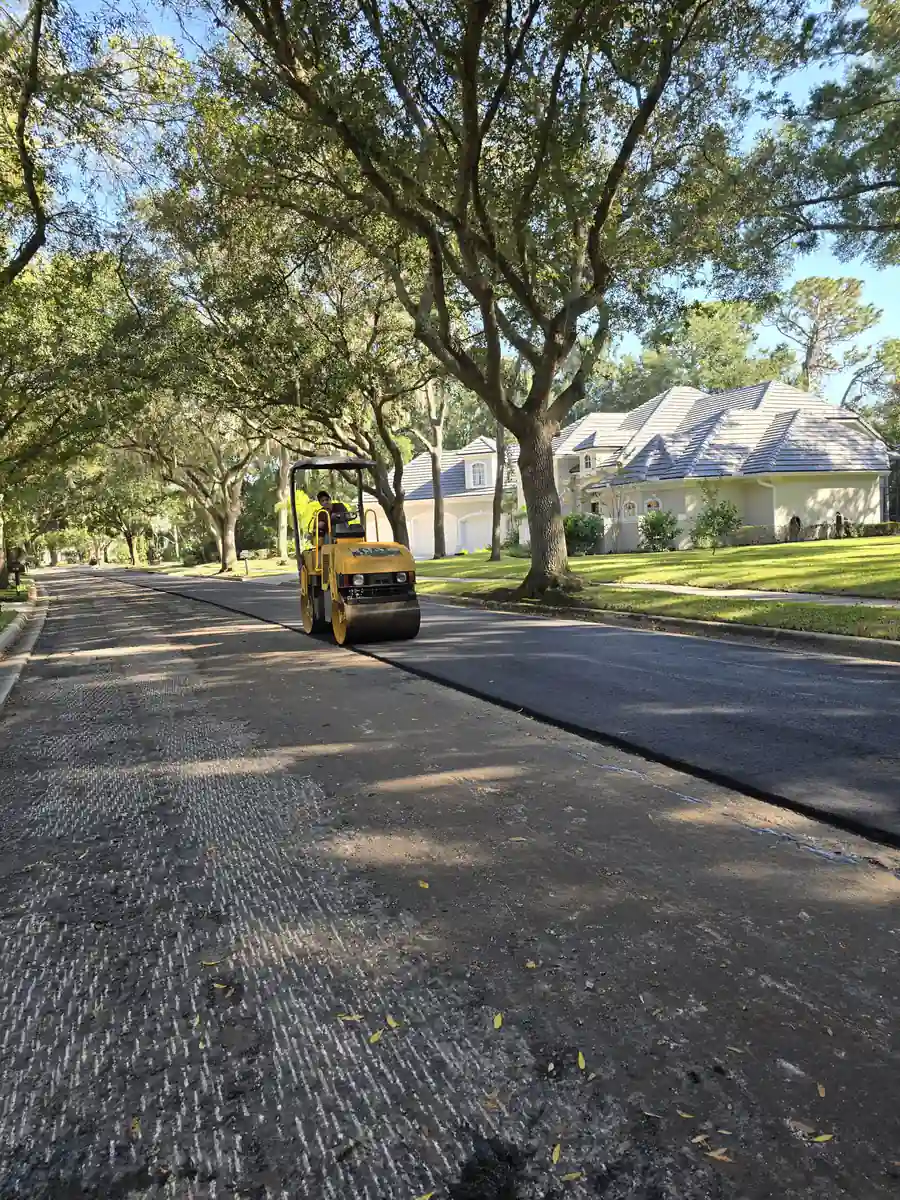
An oak-shaded residential street, milled down and repaved one half at a time so people could still get in and out of their own driveways while the work went past their house. The clips and the photo below are from that job.
Project at a glance
- Location
- DeLand, Volusia County
- Scope
- Mill and asphalt overlay
- Traffic
- One half open throughout
- Property Type
- Residential street
The Approach
How do you repave a residential street without trapping people in their driveways?
Half at a time. One side of the road gets milled and paved while the other side stays open, so somebody coming home at two in the afternoon still has a way onto their own property.
Look at the photo further down this page and you can see the swap in progress. The dark half on the right is finished asphalt. That pale corduroy texture on the left is what the milling machine leaves behind after it grinds the old surface off, and although it looks rough, it drives perfectly well. Cars used it for the rest of the day. The trick is deciding where the joint between the two halves lands, because a longitudinal joint sitting under a wheel path is the first thing to open up three summers later.
Streets like this one make the sequencing harder than it sounds. Live oaks hang low enough over the pavement that a milling machine's conveyor has to be swung and dropped to clear a limb. Every driveway apron has to tie in flush, and there are a lot of them. The curb and gutter along the edge sets the finished elevation, so the mat has to come in at a depth that leaves the gutter pan doing its job. Juan spent a good stretch of his 22 years in asphalt on DOT road work, where keeping a lane open is a condition of the contract rather than a courtesy, and that habit carried straight over to how M&S Asphalt Paving runs residential streets. If you want the same approach on your road, our asphalt paving in DeLand page covers how we scope this kind of work.
On The Job
What is the milling machine doing before any asphalt goes down?
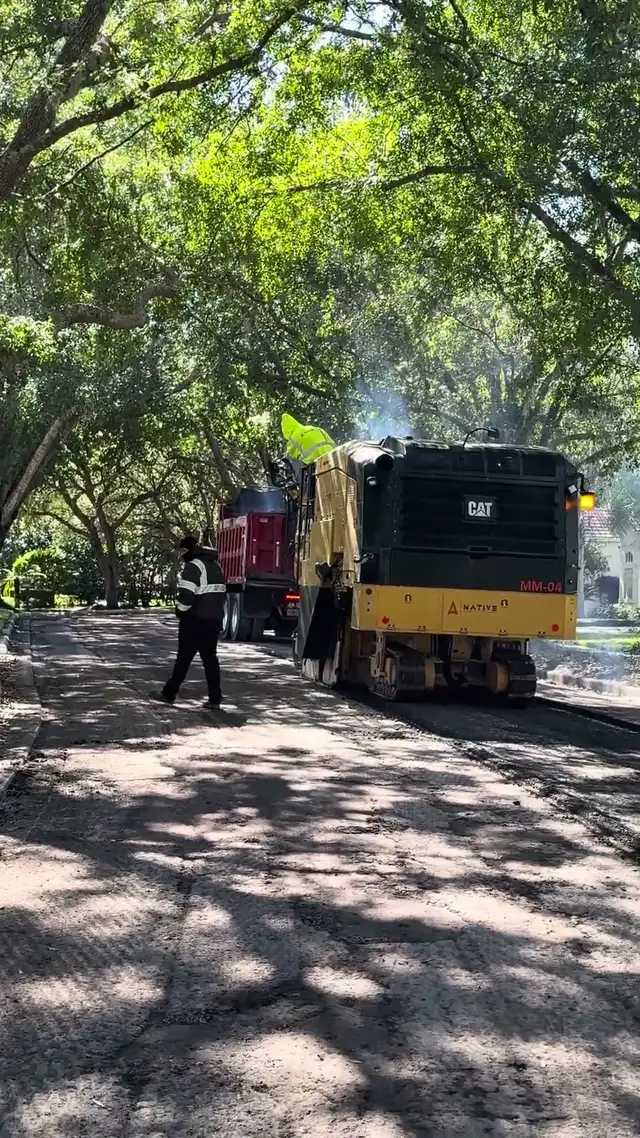
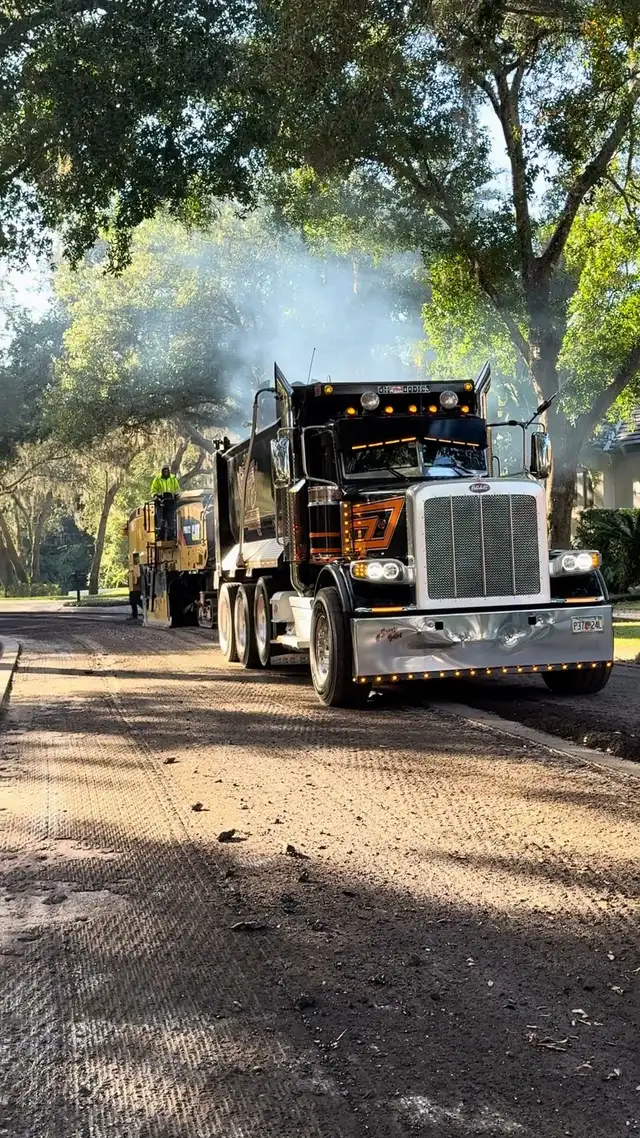
It grinds the worn top layer off the road and hauls it away, which is the step that lets a new mat sit flush instead of proud of everything around it. Both clips are from the same morning.
Skipping the milling is what causes the problems people notice a year later. Pave straight over a tired road and the whole surface rises by the thickness of the new layer. Driveway aprons end up with a lip you feel every time you pull in. The curb gets shallower, so water that used to run to the inlet now stands in the gutter. Milling first keeps the finished grade exactly where it was, which is why we do it on any street that still has a sound base underneath. Where the base itself has failed, that is a different job, and it is covered on our asphalt paving page.
Mid Job
What does the halfway point actually look like?
Deciding Factor
When is a street ready for a mill and overlay instead of another round of patching?
When the cracking has stopped being a few isolated spots and turned into a pattern across the whole surface. At that point every patch you add is buying months, not years, and you are paying twice for the same stretch of road.
The tell most boards and homeowners recognise is patch density. Once you can stand at one end and count more than a handful of dark rectangles, the surface has generally lost the binder that held it together, and the next crack will open somewhere the patch is not. Raveling is the other signal. Loose stone collects along the curb line after rain, which means the asphalt is shedding aggregate rather than flexing with the heat. A surface we lay is built to give ten to fifteen years in Florida sun, so a road showing that behaviour well inside that window usually has a drainage problem worth finding before anyone repaves anything.
None of that means milling is automatically the answer. A road with sound structure and a handful of genuine problem areas is often better served by crack filling and repairs, done properly, followed by asphalt sealcoating on a sensible cycle to keep water out of the cracks you already have. We will tell you which of the two you are looking at when we come out, and we will tell you if the honest answer is that you have a few years left.
Want to see another job?
The cul-de-sac project shows the same crew working a tighter, more awkward shape, where the paver has to run a curve and the roller has to seal right up against the curb.
Have a street or a driveway that needs the same treatment?
Call and describe what you are looking at. We come out, walk the surface, tell you whether it needs milling or just repair, and give you a straight price either way. Most estimates go out same day or next day.
Call us today (386) 215-7466