Cul-de-Sac Asphalt PavingMaitland, Florida
A Maitland cul-de-sac rebuilt from the ground up, with a stone base compacted over the orange subsoil before the asphalt arrived. Every photo on this page was taken during the work and is labeled.
Project at a glance
- Location
- Maitland, Orange County
- Property
- Residential cul-de-sac
- Scope
- Base work and asphalt paving
- Equipment
- Paver, roller and plate compactor
The Ground
What does the ground look like under a cul-de-sac before it is paved?
Orange. The bare ground in this photo is the subsoil that turns up rust colored whenever Central Florida gets dug, and it is not something you pave on directly.
Before any asphalt, the crew spreads crushed stone over it and compacts it with the plate compactor in this frame while a second crew member shovels stone into the low spots. Stone drains and holds its shape. Orange subsoil does neither once it gets wet. Then the crew checks the grade again before any mix is ordered, because fixing a low spot in stone costs minutes and fixing it in asphalt costs the surface.
Maitland's older streets sit among mature oaks and small lakes near Lake Lily Park, so we look for roots and soft spots before we compact. That is the kind of sitework and site preparation that decides how the surface looks in ten years, and it is the part of the job M&S Asphalt Paving will not rush. A stone base costs time up front. It saves the street later.

The Curb Line
How does the crew get the base tight against the concrete curb?
By hand, with a plate compactor. A roller cannot reach the gutter line without climbing the concrete, so the edge belongs to a person walking the machine.
The base at the curb has to be as hard as the base in the middle. The edge is where water enters. A soft edge shows up first as a dip along the gutter. In this frame the stone is shaped and compacted right up to the new concrete, and the crew member in the middle is pushing the compactor along the curb while a second worker shovels stone into the low spot behind him.
Storms in Orange County send water straight down the gutter line to the drains, so a low spot at the curb gets tested often. A dip there collects water, and water at the base of a curb finds its way under the mat. If the concrete itself needs work first, our concrete services cover curbs and aprons.

The Paver
How does a paver lay asphalt around a tight turn?
In short, steady passes, with a crew member shaping the edge right behind the screed. It never rushes the curve.
A cul-de-sac bulb is an arc, and the paver has to follow it without letting the mat bunch on the inside or thin out on the outside. In this frame the paver sits at the dirt end of the bulb with the finished arc running back to the street, and the orange cones keep the work zone clear. The long rake in the corner is what finishes the edge the screed cannot reach.
Maitland sits just north of Orlando, so our asphalt paving in Orlando page applies to jobs like this one, whether the road is public or belongs to an HOA. Residents get their driveways back as soon as the mat has cooled. A cul-de-sac gives you one chance at the arc. Nobody rides the paver faster than the roller can follow.

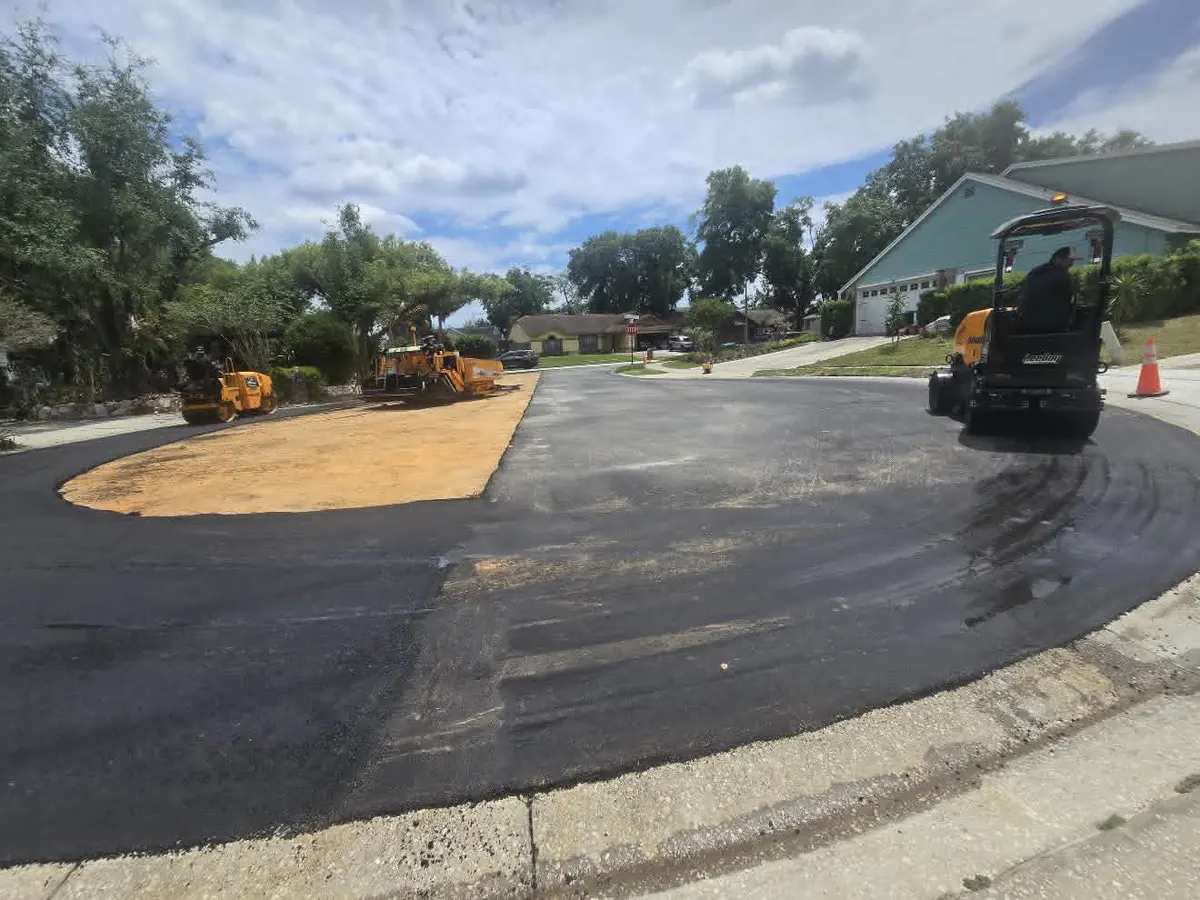
Halfway
How far along was the job at the halfway point?
The black arc is laid and a roller is still working the right side of it. On the left, the paver and a second roller sit on the bare orange ground, which is the next section to get stone and mix.
The Roller
Why does the roller follow the paver so closely?
Because compaction decides how long the surface lasts. Our standard is two inches of asphalt over a hard base, and a surface built that way gives ten to fifteen years of life.
The roller in this frame carries our own lettering. It works the new bulb in overlapping arcs while the paver keeps going farther back, so the curve comes out smooth and the bare ground beyond it is still waiting its turn. Rolled hot, the surface closes up. Rolled late, it stays open and takes on water.
The same sequence of base, paver and roller applies to a driveway, only at a smaller scale. See our driveway paving page if the aprons on your street need work too. That matters on a street where every driveway apron has to tie into the same mat. Our crew checks that each apron ties in flush, so nobody bumps over a lip on the way in.

Want to see another cul-de-sac?
The DeLand cul-de-sac shows the same paver and roller sequence on a bulb ringed by concrete, with job video.
Need a cul-de-sac or private road paved in Orange County?
Call and tell us what you are dealing with. We come out, look at the surface and the drainage, and give you a straight price with the scope written out, in English or Spanish.
Call us today (386) 215-7466